Guide to selecting TMR Hall analogs for Dualshock Dualsense Switch Xbox controllers
Due to many questions about analogs, we decided to write a guide that will contain answers to the most frequently asked questions. In this article, we will try to gather the most important information, describe the differences between the products available in our offer, and suggest the best choice. We will try to translate the information contained here into understandable language; there will be a bit of theory and information in the form of Q&A.
Is TMR technology and the Hall effect a new technology?
Motherboards using Hall analogs were first used by Sony in Dualshock 3 controllers. The famous 4-pin analogs are nothing more than Halls. Anyone who services controllers knows that they are practically indestructible.
The use of Tunnel Magnetoresistance (TMR) technology is possible thanks to 2 scientists. Messrs. Albert Fert and Peter Grunberg received the 2007 Nobel Prize, and are honorarily called the "Fathers of Hard Drives". TMR technology debuted in data storage in 2004, significantly increasing data density. The company GuliKit, considered one of the pioneers of this technology, produced the first units in 2024.
Is it worth using magnetic analogs (Hall and TMR)?
What are the advantages of magnetic analogs over traditional (resistive) ones?
In classic analogs (ALPS, Favor Union), the deflection of the stick is related to the displacement of the potentiometer (variable resistor); the whole mechanism is therefore 2 potentiometers operating in a cross arrangement. The construction of potentiometers is based on a slider moving along a resistive track. Depending on the deflection angle, the resistance decreases or increases, resulting in 2 voltages for one axis. The biggest advantage of this solution is the linear change in resistance and high accuracy. The biggest disadvantages are the technological problem of obtaining products with similar parameters (production accuracy is about 20%) and the natural wear of the track (there is constant friction between the slider and the track, which together with dust and other contaminants accelerates the degradation of the potentiometer). After removing the wheel, the wearing graphite (or other resistive material) is perfectly visible.
In magnetic analogs (Hall and TMR), there is no friction, and the resistance value does not depend on the position of the slider on the track but on the relative position of the magnet and the sensor. By eliminating friction, we get rid of excessive wear of the sticks.
What is the difference between Hall analogs and TMRs?
I cannot answer this question precisely; both types use the same magnet and sensor. For us, however, the most important thing is that TMRs have a much lower power consumption, which significantly increases the controller's battery life. It is commonly accepted that TMRs are newer and more technologically advanced.
Which magnetic analogs are the best?
There is no clear answer to this question. We assume that one needs to try working with different products and then can comment. We make sure that the assortment we offer is of the highest quality. Every product in this world has its supporters and opponents. We leave the choice to our customers.
Do magnetic analogs require calibration?
Yes, all mechanisms after replacement must be calibrated because we do not know the parameters of the old and new component. Unfortunately, we do not have the appropriate tools for all platforms. Work and research on calibration methods for more platforms are ongoing.
Why are there so many versions of magnetic analogs? Are they interchangeable? Do the colors of the sensors matter?
Each manufacturer offers at least 4 types of analogs. They differ in the colors of the sensors (the ones that replace potentiometers). In the case of classic potentiometers (acting as a voltage divider), it does not matter much to which leg (1 or 3) we supply the supply voltage and to which we connect ground. In the case where instead we have electronic circuits checking the magnet's position, it is important whether they are correctly powered - this is the basic difference between potentiometers in PS4 or Xbox controllers.
- Dualsense - has 2 identical sensors (of the same color)
- Dualshock 4 - has 2 different sensors (power supply on different legs)
- Xbox Series - as above, also 2 different sensors, interestingly swapped relative to the PS4 version
- Nintendo Pro - 2 identical sensors as in Dualsense
Interchangeably, analogs intended for PS4 and Xbox can be used, but one must remember to swap the sensors. In the past, analogs for Xbox were divided into those for Series (which can be calibrated) and those for older controllers (which drifted after calibration) having 2 holes for setting the magnet mechanically.
Which controllers can be calibrated?
- Sony Dualshock 4, Dualsense, Dualsense Edge controllers can be calibrated using special scripts and using the website https://dualshock-tools.github.io/
- Xbox Series Model 1914 and Elite 2 Model 1797 controllers (all with a USB-C port) can be calibrated using the official Xbox app and from the console level
- Xbox One (with microUSB port) controllers - currently only model 1708 can be calibrated with the official Microsoft tool after first flashing via the website https://driftguard.app/ to version 1914; for the others, it is best to use analogs adapted for mechanical calibration
- Xbox 360 controllers - can also be calibrated via the website https://driftguard.app/
- Nintendo Switch PRO, Joy-Con controllers - calibration via https://driftguard.app/ and from the Nintendo Switch console level
Other controllers can be calibrated using appropriate analogs, drift-fixes, or mechanical calibration. There is no single simple solution as in the above-described ones
Why are there so many versions to choose from in the konsolowo.pl offer?
Unlike some online creators, we do not enter into paid collaborations and do not promote a specific manufacturer. From the beginning, our company's mission has been to provide the widest possible range of replacement parts for consoles.
Mechanical calibration, how to perform it and can it be done in all analogs? What is the difference between Xbox and Xbox Series analogs?
Unfortunately, this calibration is only possible in the oldest Hall and TMR analogs. It is related to the shape of the magnet and, in short, involves physically repositioning the magnet inside the analog. To do this, block the mechanism with two holes located in the sensor and counter the pin so that the gear jumps. This possibility was removed in newer analogs with the introduction of the calibration tool for Xbox Series controllers. At this moment, it is the best method for calibration.
Xbox One and Xbox Series analogs are electronically the same product. The distinction occurred when the calibration tool was introduced, which ruined the calibration in model 1914. After changing the magnet shape, the calibration stopped drifting, but we lost the ability to manually set the analogs.
How to test analogs in a controller?
There are many websites online providing a calibration tool:
We especially encourage using the first link; we have an ongoing contribution to the construction of this site:
Other sites for testing and calibrating controllers:
Which analogs are best for Elite 2 controllers?
In the Microsoft Xbox Elite 2 controller, the magnets from the interchangeable thumbsticks cause the most problems. TMR analogs simply drift due to the magnet's influence. Hall analogs can be used after setting them mechanically. Calibration with official software will cause improper operation.
Is replacing analogs easy?
No, replacing analogs is one of the more difficult repairs performed on controllers. The very large area to heat, poor-quality vias in the motherboard, delicate laminate susceptible to scorching and other damage are problematic. It is the most common fault occurring in controllers but at the same time causing the most problems for technicians.
What are the differences in TMR analogs available at konsolowo.pl?
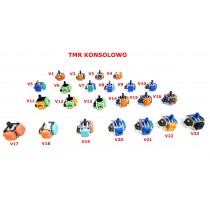
First, I will add that our designations V1-V22 are completely random and appeared with the introduction of new products and manufacturers to the offer. On each product card, it is clearly stated which controllers it is suitable for.
Differences in TMR analogs available in the Konsolowo offer:
- V1 - first version of Ginfull used for Dualsense PS5
- V2 - first version of Ginfull used for Xbox Series 1914
- V3 - first version of Ginfull used for Dualshock 4 PS4
- V4 - first version of Ginfull used for Nintendo PRO
- V5 - first version of K Silver used for Xbox Elite 2
- V6 - Favor Union for Dualsense, with 100GF spring
- V7 - K Silver for Dualshock 4
- V8 - K Silver for Xbox Series 1914
- V9 - K Silver for Nintendo PRO
- V10 - K Silver for Dualsense - version JS13 PRO+
- V11 - Favor Union for Dualsense
- V12 - Favor Union for Xbox Series 1914
- V13 - Favor Union for Dualsense with a weaker 80GF spring
- V14 - ALPS analog base with Ginfull potentiometers for Dualsense
- V15 - ALPS analog base with Ginfull potentiometers for Xbox 1914
- V16 - ALPS analog base with Ginfull potentiometers for Dualshock 4
- V17 - second generation Ginfull DS13MAX for Dualsense PS5
- V18 - second generation Ginfull DS13MAX for Xbox Series 1914
- V19 - second generation Ginfull DS13MAX used for Dualshock 4 PS4
- V20 - Aknes HallPi analog for Dualsense PS5
- V21 - Aknes HallPi analog for Xbox 1914
- V22 - Aknes HallPi analog for Dualshock 4
- V23 - Aknes HallPi analog for Nintendo PRO
Additionally, 4 versions of sets with GuliKit thumbsticks
What are the differences in HALL analogs available at konsolowo.pl?
As with TMR, we divide Hall analogs into models from V1-V11 based on manufacturers and purpose.
Differences in HALLA analogs:
- V1 - Ginfull - works only in PlayStation 4 Dualshock 4 (all revisions) controllers
- V2 - Ginfull - used for PlayStation 5 Dualsense (all revisions) controllers
- V3 - Ginfull - works only in Xbox One and Xbox Series (in the case of Elite 2, the thumbsticks must be changed to plastic) controllers. This analog has been replaced by version V8 because calibration with the official Xbox tool does not work on it. However, it has pins for mechanical adjustment, so it is suitable for older Xbox controllers (including Elite 1)
- V4 - Ginfull for Switch PRO controllers
- V5 - K Silver - has a threaded pin used only in Xbox Series Elite 2
- V6 - Ginfull - improved version of analog V2 for use with Dualsense controllers
- V7 - Ginfull - improved version of analog V1, for use only in Dualshock 4
- V8 - Ginfull - improved version of analog V3 used in Xbox Series Model 1914, can be calibrated with the official Xbox tool
- V9 - Favor Union version for Dualshock 4
- V10 - Favor Union version for Dualsense PS5
- V11 - Favor Union version for Xbox Series 1914
Summary.
The topic remains open; we will try to update it on an ongoing basis with new analogs available in our offer and new calibration methods. The guide should be treated as guidelines and, despite all efforts, may contain errors. Analog replacements should be performed by experienced technicians and all are done at your own risk. As we receive further questions, we will add answers here.

 Polski
 English